Pads & Purpose: The Origin Story
“Giving is a way of asking; asking is a way of giving.” – Luigina Sgarro
It took me a year and a half to figure out that I was measuring leadership completely wrong. But before I tell you what I mean, let me tell you a story.
Almost a year and a half ago, I was a girl who wanted to build something from scratch in the middle of Silicon Valley’s women’s health world
I was reading the books, attending the events where rooms full of impressive female founders discussed their apps and startups.
Most of all, I desperately wanted to be a part of this community in which women were solving problems for other women. It was such a refreshing change of pace from the brotech fraternity that otherwise makes up Silicon Valley.
The seed is planted.
Initially, I assumed I would eventually weasel my way into some techy internship come summer, much like all my peers seemed to be trying to do. Reckoning with my unfortunate aversion to programming and my steadily growing interest in data science and statistics, I settled on the idea that I would hustle to get an internship in one of these women’s businesses.
Among that frenetic, uncertain period of searching my soul for the best career direction and searching San Francisco for internships, I was sitting in the airport with my friend as we were waiting to take off for spring break in LA.
I had just read Caroline Criado Perez’s international bestseller Invisible Women, and this silly idea came over me: Wouldn’t it just be sooooo cool if I could make a comic book all about periods, but instead of awkward and sterile, make it fun and playful so that kids actually feel empowered and not like rolling their eyes?
The seed actually takes root (oh no).
I was starting to make peace with the actual chance of landing a paid summer internship in the women’s health world (don’t worry- I most certainly landed a very sketchy unpaid one).
So when I mentioned the idea to my friend, and she confirmed that it was indeed a cool idea, I felt pretty good.
Knowing that I must mitigate for my shameful propensity to overcommit, I sent a message in our cohort group chat. It was a low commitment message that was aimed at testing the waters.
So, of course, it was pretty mind-boggling when within the next 24 hours, I had about 17 of my friends text me individually to say they loved the idea and wanted in.
Not knowing that I must mitigate for their propensity to overcommit, the group of people interested in bringing the idea to life ended up being about ten or so.
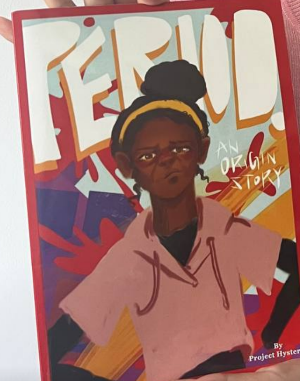
Still, it felt really good to reach the end of the summer with a comic book complete, and by fall, we had it published on Amazon as Period: An Origin Story.
Now people…expect things of me??
Now you might be thinking, “Wow, so that must’ve felt really incredible after all that, right?
“You mobilized and inspired a group of 10 unpaid college students to make a comic book that months before was just a dream you had in an airport lounge; you crowdfunded on Kickstarter independently and (eventually, after much procrastination) fulfilled the orders, you donated copies to schools internationally, plus got to host a menstrual destigmatization workshop in Japan. That’s some solid work.”
That thinking would make logical sense. In theory, I should feel great. I should feel like a true leader.
Except…not really.
“Do you wish to rise? Begin by descending.” – St. Augustine
The reality is a bit messier, and if I were completely honest, right from the beginning, I struggled.
Setting up the Kickstarter scared me. Letting my friends down scared me. Getting in over my head scared me.
I worried that people would push me to take the project to a level at which I couldn’t actually lead it.
When would they find out that I was actually super lazy, and most of the time I took one look at my “to do” list and pushed important tasks to “tomorrow” (except “tomorrow” seldom became “today”)?
Then, Amazon kdp scared me, and for weeks I struggled just to get our finished product up on the platform. I spent hours frustrated, trying to resize the cover, and then another thing would go wrong, then another.
Once that was sorted out, what scared me was fulfillment. Would people be annoyed that I fulfilled their orders late? Sure, I sent a message in the Kickstarter explaining the situation, but still.
Then I was scared because we got the opportunity to do workshops in a high school in Tokyo, and well, I had zero experience with that so clearly it would be a disaster.
Okay, maybe the workshops turned out okay, but then it was the intense dread that came when the Kickstarter money ran out, and now how will I keep this up.
And oh, by the way, I also have to distribute to bookstores.
And do I have any clue how to do that? No. To be honest, I can barely figure out how to open a bag of frozen vegetables most days.
And while I am currently figuring it out, it also petrifies me because, yet again, I have no clue what I’m doing, and most of my little experiments to try and get my foot in the door only end in failure.
Realizing that being afraid (and often oblivious) doesn’t make me a fraud.
“A man who wants to lead the orchestra must turn his back on the crowd.” – Max Lucado
So the answer to “Don’t you feel amazing?” is usually a definitive “Nope- I actually feel like a piece of trash who cannot be trusted with anything”.
But then, about 5% of the time, my answer is, “This is a dream come true, and I am honored to bring this project to the world.”
Because of the complex mental battle that comes with doing a lot of things you have no idea how to do, all in rapid succession and with an audience, it took a long time for me to take ownership of Project Hysterica, and our comic book and workshops.
I could not say, “This is my non-profit. I am a leader with an amazing team. This is my plan, and I am in charge.” because saying, “This is my passion project. I am an idiot. I don’t have a plan. Why are people expecting things from me?” let me evade the responsibility and growth that I needed to undergo.
Of all that I have learned how to do in the past year, saying “this is mine and I am responsible” (“It’s my fault and I’m sorry”) has been (and still is) one of the most uncomfortable lessons. Using the phrase “non-profit” versus “summer project” forces me to take our work seriously.
Coming into meetings with a plan, as opposed to excessively inquiring with others about what they think I should do means taking myself seriously as a leader.
It means honoring my original silly- but maybe not-so-silly- vision.
But most of all, it means deciding that I can be an idiot at the same time as I can be a good leader.
And maybe owning up to my complete and utter foolishness is the first step towards honoring that vision.
Not a one-woman show
“Asking for help with shame says: You have the power over me. Asking with condescension says: I have the power over you. But asking for help with gratitude says: We have the power to help each other.” – Amanda Palmer
I didn’t learn how to take responsibility alone. Of course I didn’t, because like I said before, I am, at my very core, still an idiot.
No, I learned to finally step into the discomfort of taking responsibility and ownership by surrounding myself with a team of friends, mentors, and other cheerleaders whose vision for this project stretched even beyond mine.
In fact, their belief not only in the project, but in me, stretched beyond mine.
And for that, I am eternally terrified and grateful.
Terrified, because I worry that maybe they don’t understand the true extent of my incompetence.
And grateful, because through others believing in me, I understand the true extent of my incompetence.
By that, of course, I mean that with baby steps, I am becoming less incompetent.
The Things That Still Scare Me About Leadership
However, that doesn’t mean I walk around with a brazen numbness to fear or doubt.
In fact, I tried to think of how to eloquently outline all the facets of leadership that still scare me, but I am only left with a long and random list of scary stuff:
#1: Disappointing people when I inevitably screw something up
#2: Waking up one day and everyone realizing that I’m a complete moron and why do they even give me responsibilities at all (why do I give MYSELF responsibilities?)
#3: Spending hours resizing on Amazon KDP
#4: Vistaprint
#5: The color red on my spreadsheets when we run out of money.
#6: Kickstarter.
#7: Anything that feels remotely administrative, or that has a deadline.
#8: The law.
#9: Biting off more than I can chew.
#10: Answering emails.
#11: Not answering emails.
#12: Saying something stupid.
#13: Saying something smart and giving others expectations of me that are too high.
#14: Having no money.
#15: Having too much money and managing it poorly.
And yet, somehow, none of those things stopped me. That confused me for a while.
Why I have decided to not give up on the whole thing.
So, you might wonder, with all those fears, why do I not give up on the whole thing?
How did I finally get to the point where I don’t feel like claiming this project as my own is fraudulent?
Well, it was a long and winding road, and the obvious first answer is that I still believe in that first vision I had in the airport all that time ago.
I think our comic book would have saved me a lot of grief if someone had put it in my hands at ten years old.
Maybe, when I had my period for the first time, I wouldn’t have been as bummed out as I was.
Perhaps I wouldn’t have stuffed my underwear with toilet paper and shame, and instead gathered the courage to ask if I could buy a box of pads.
Our comic book is not the end-all-be-all solution to menstrual health stigma, but I believe with all my heart that it is a really strong step in the right direction.
Success is the vision that outlives you.
But the second reason I haven’t given up is that my definition of what makes a successful leader has changed.
A year ago, my definition was something like “a successful leader is one who sleeps 4 hours every night, does everything herself, and is pretty much invincible”.
I tried to be that woman- and maybe she exists out there- but I couldn’t do it.
But now, after failing over and over again, I realize I got it wrong.
A successful leader isn’t the one who gets it perfect every time, in rapid succession, when trying to take on everything at once.
No, a successful leader is one who builds something that survives even when they’re gone. Successful leaders make themselves redundant. They craft systems which perpetuate growth.
So for me, it means growing and learning steadily, messily, and frustratingly, until one day my vision can sustain itself.
Of course I’m pretty far away from that point, but it’s a much more attainable goal. It’s something I can work with, and it completely changes my approach to leadership.
Now, I invest my energy in learning how to delegate, how to automate, how to pivot and iterate when something doesn’t work.
I have gone from thinking in terms of brute force to thinking in terms of systems and efficiency, because a system becomes automatic soon enough, while a procrastinated-on task just wastes energy.
What I Got Wrong About Leadership (And What Actually Works)
“A leader is best when people barely know he exists, when his work is done, his aim fulfilled, they will say: we did it ourselves.” – Laozi
This is a world where getting a full night’s sleep is considered an act of resistance.
So as a subversive, daresay, feminist young woman, I’m all about that.
The best thing I ever did for my development as a leader has been to finally acknowledge that I’m not super woman. My day doesn’t consist of 30 hours. I need to ask for help often. And, alas, I actually need sleep to function without murderous intentions.
So when I sink into the occasional haze of depression and self-doubt, what keeps me afloat is not self-love or optimism. It is systems that make success inevitable.
Confidence = data, and having a system that makes success inevitable gives me all the data I need to get back on track.
Why? Because actually, I’m not unstoppable. Usually, I’m a complete idiot. I need sleep at night. I want my comic book to outlive me. And I wanna roller skate in a parking lot at sunset.
Fortunately, as it turns out, you can be a leader while all those things are true.
Thought to Action
#1: Write down one task you’ve been avoiding for more than two weeks. That’s your first automation or delegation candidate.
#2: Replace “I’ll do it tomorrow” with a specific time and day. Tomorrow isn’t a time.
#3: Ask one person interested in helping you to own one thing. Not help. Own.
#4: Turn Discomfort Into Question Curiosity: Instead of “Why did I fail?”, ask “What did this effort teach me about what matters?”.
#5: Separate Skill From Identity: You don’t need to be “good” at something for it to matter to you.
Sources
Criado Perez, C. (2019). Invisible women: Data bias in a world designed for men. Chatto & Windus.
AI Statement
Where was AI used?
SEO keyword research & optimization: This is the boring bit that has to do with aligning what I write with what search engines will put at the top of their pages. I let AI do it so I can focus on being a better writer (my specific AI buddy is Claude).
Additionally, ⅗ Thought to Action items in this post were integrated from a brainstorming session with Claude.
Where was AI not used?
Image generation: A human being took and selected every photo used in this post.
In any writing, at any point: A human being wrote this post with her heart and brain, not her LLM friends.